
What is GEO? The SaaS Writer's Handbook
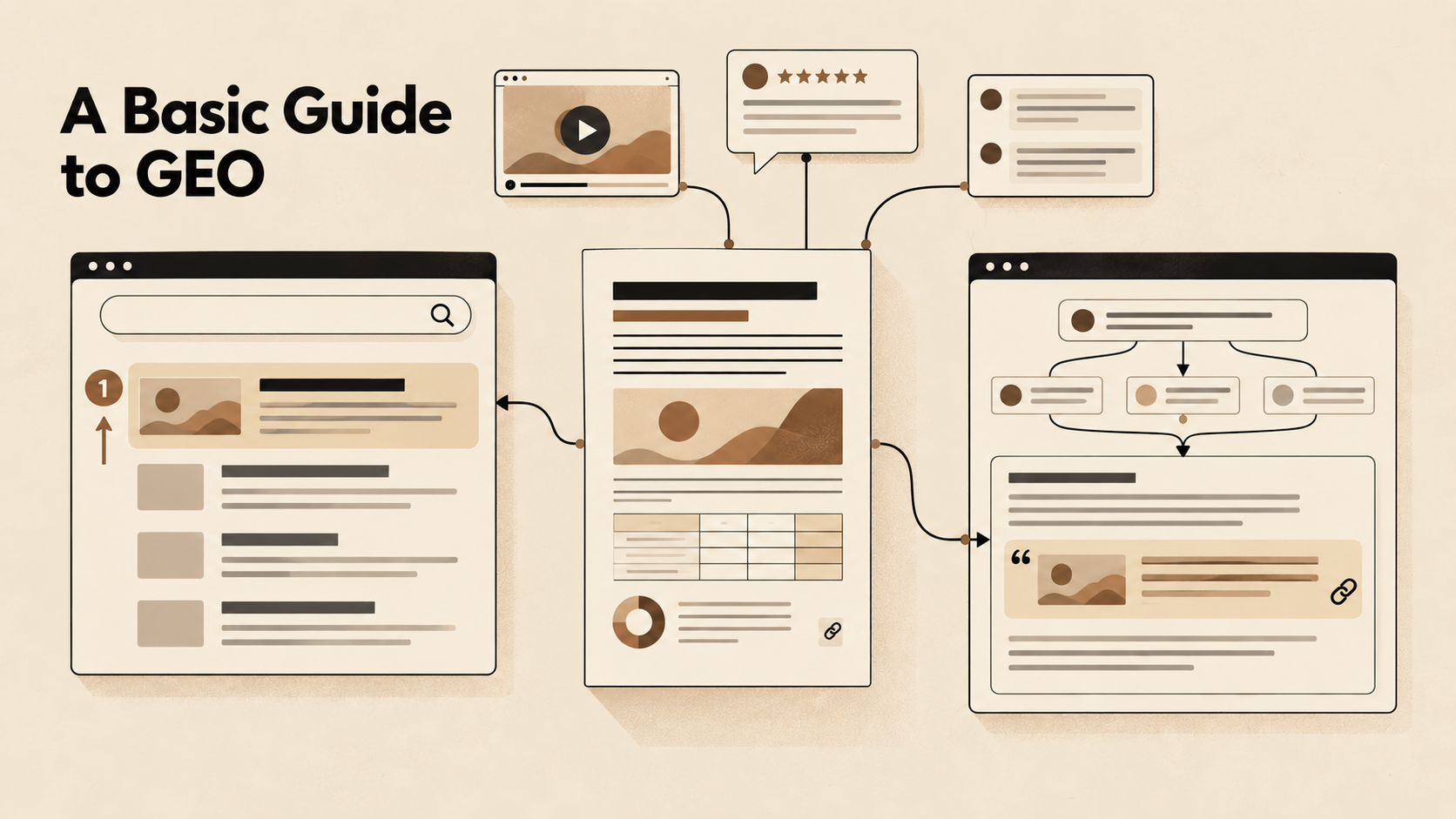
Last year, I was on a call with a SaaS founder who had just hit something most content teams spend months chasing. His blog ranked #1 on Google for "best CRM for startups." Thousands of monthly impressions. Strong click-through rate.
Then I asked him to try something. He typed the same query into Perplexity.
His article didn't show up. Not at the top, not anywhere in the answer. Perplexity had synthesized a response from three other sources, none of which were ranking #1 on Google for anything.
The search intent was the same, but different channels had different results. That moment is what this guide is about.
In short, GEO is the practice of structuring your content so AI tools like Claude, ChatGPT, and Perplexity cite it in their answers. Not so your page ranks. So your brand gets named when someone asks an AI what to use.
I've been tracking this shift since early 2025. This handbook breaks down what GEO is, how it differs from traditional SEO, and what SaaS writers need to do differently to stay visible across both channels.
TL;DR
GEO (Generative Engine Optimization) is the practice of structuring content so AI tools like Claude, ChatGPT, and Perplexity cite it in synthesized answers. SEO gets you ranked. GEO gets you named.
AI referral traffic converts more than traditional SEO traffic, because LLMs pre-qualify buyers before they ever click through.
AI models evaluate content on four signals: structure and extractability, evidence and specificity, first-hand knowledge, and cross-web authority. Backlinks carry very little weight.
Query fan-out means one buyer prompt becomes multiple sub-searches simultaneously. The article that answers the most sub-queries gets cited, not the one ranking #1.
GEO and SEO aren't competing strategies. Write for the buyer first, structure for AI extraction second, optimize for keywords third. That order builds for both channels at once.
What is GEO?
Generative Engine Optimization (GEO) is the practice of structuring your content and digital presence so that AI search engines (Claude, ChatGPT, Perplexity, Google's AI Overviews) select, cite, and recommend you within synthesized answers.
In simpler terms, GEO is SEO for AI.
Where SEO asks "How do I rank on Google?", GEO asks "How do I get cited when someone asks an AI the same question?" Google's algorithm crawls keywords, links, and engagement metrics. AI models crawl those too.
But they evaluate content through a different lens:
Structure: How clear and extractable is the answer?
Authority: Does this writer clearly know what they're talking about?
Evidence: Are claims backed by data, examples, or first-hand testing?
Depth: Does the answer cover edge cases, nuance, and real-world complications?
Get these right, and your article might get cited, quoted, and pulled directly into an AI answer.
Why does GEO matter for SaaS content teams?
GEO matters because AI search is becoming a major discovery channel for software buyers, and it works very differently from Google. I was recently watching a video on Neil Patel’s channel where he broke down an NP Digital study covering 500 commercial keywords and 4,300 LLM prompts.
The numbers show just how big the shift is:
Triple the conversion rate: AI referral traffic converts at roughly 9%. That’s more than 2x SMS and over 3x paid search or traditional SEO. One reason is that LLMs already help buyers narrow their options before they reach your site.
Google rankings don’t tell the whole story: Ranking #1 on Google gives you only a 31% chance of being cited in an AI answer. Even more interesting, 75% of AI citations come from sources outside Google’s top 10.
So if you’re only optimizing for Google, you could be missing the channel that’s sending you some of your highest-intent traffic.
How do GEO and SEO differ
SEO is about getting your pages to rank in traditional search results, whereas GEO is about getting your brand or content cited in AI-generated answers. SEO tries to win the click; GEO tries to become part of the answer.
GEO and SEO aren't mutually exclusive. The best SaaS content does both. It ranks on Google and gets cited by AI.
But if you have to choose, and you have bandwidth for only one approach, GEO is the stronger bet for the next 24 months. The space is wide open. Competition is low. And the winners are being decided now.
Dimension | Traditional SEO | Generative Engine Optimization (GEO) |
Search Mechanism | Single keyword matching against indexed pages | Query fan-out: LLMs split long prompts (5x longer than keywords) into multiple sub-searches and aggregate results |
Evaluation Unit | Full page/URL level | Passage-level (40-to-60-word direct answer blocks) |
Authority Driver | Domain authority and backlinks | Cross-web consensus, YouTube visibility, third-party mentions. Domain links show near-zero correlation with AI citations. |
Content Lifecycle | Static/evergreen; ranks for years without updates | Freshness bias: AI-cited content is 26% fresher; decay after 18 months without updates |
Measurement and Result | Rank #1 = 31% citation chance; Rank #4 = 2.6% | 75% of AI citations come from outside Google's top 10; AI referral traffic converts at ~9% (2-3x higher than traditional channels) |
I ran the same query on Google and ChatGPT while writing this
The query was simple: "What are the best AI content agencies in India?" But not a single agency appears in both results.
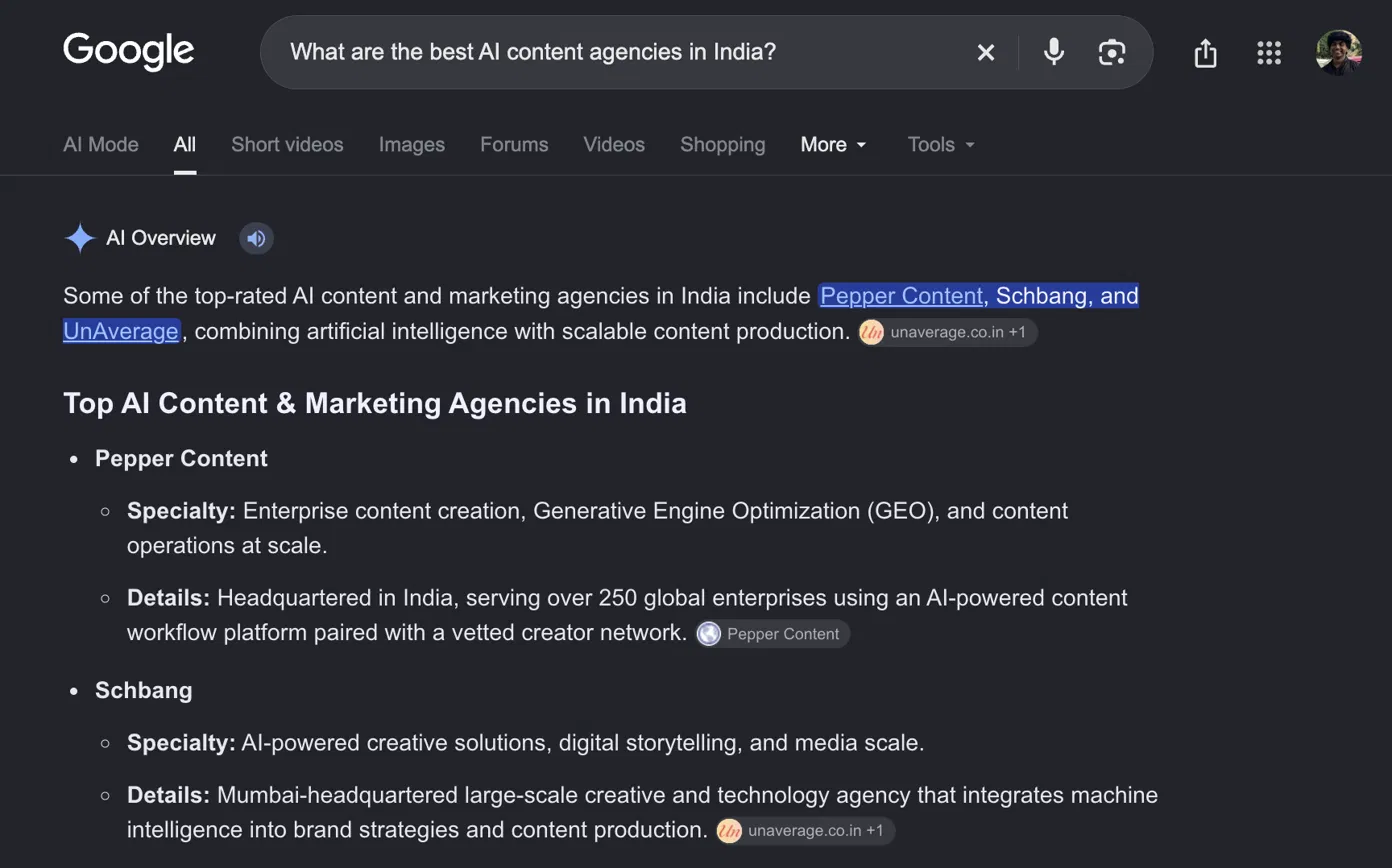
Google surfaces Pepper Content, Schbang, and UnAverage.
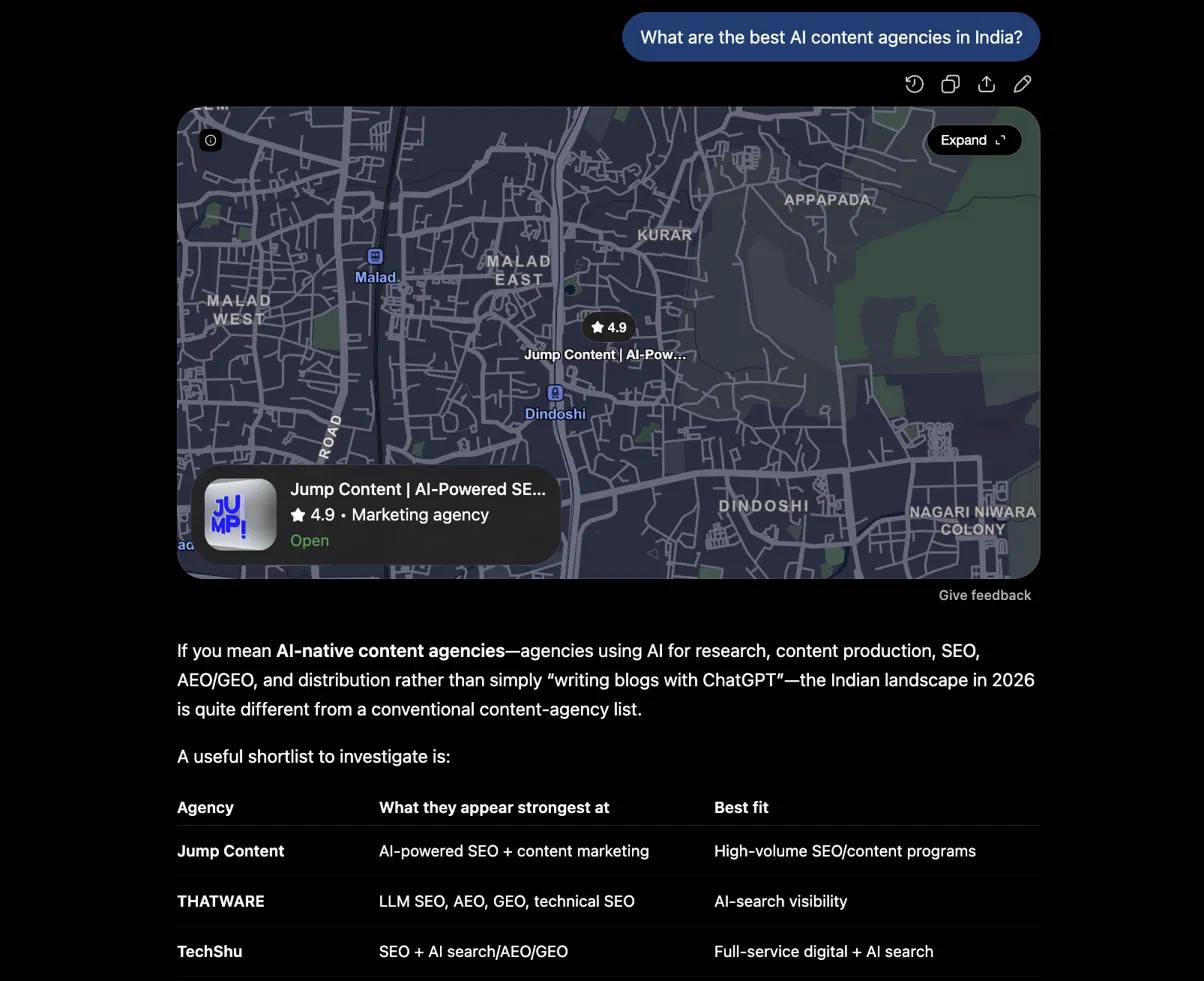
ChatGPT surfaces Jump Content, THATWARE, and TechShu.
Even with the same intent, there were different results. As the comparison shows, Google and AI search pull from different content pools, so optimizing for one won't secure your spot in the other.
High-performing SaaS content bridges this gap by combining SEO rankings with GEO citations.
How AI models decide what to cite
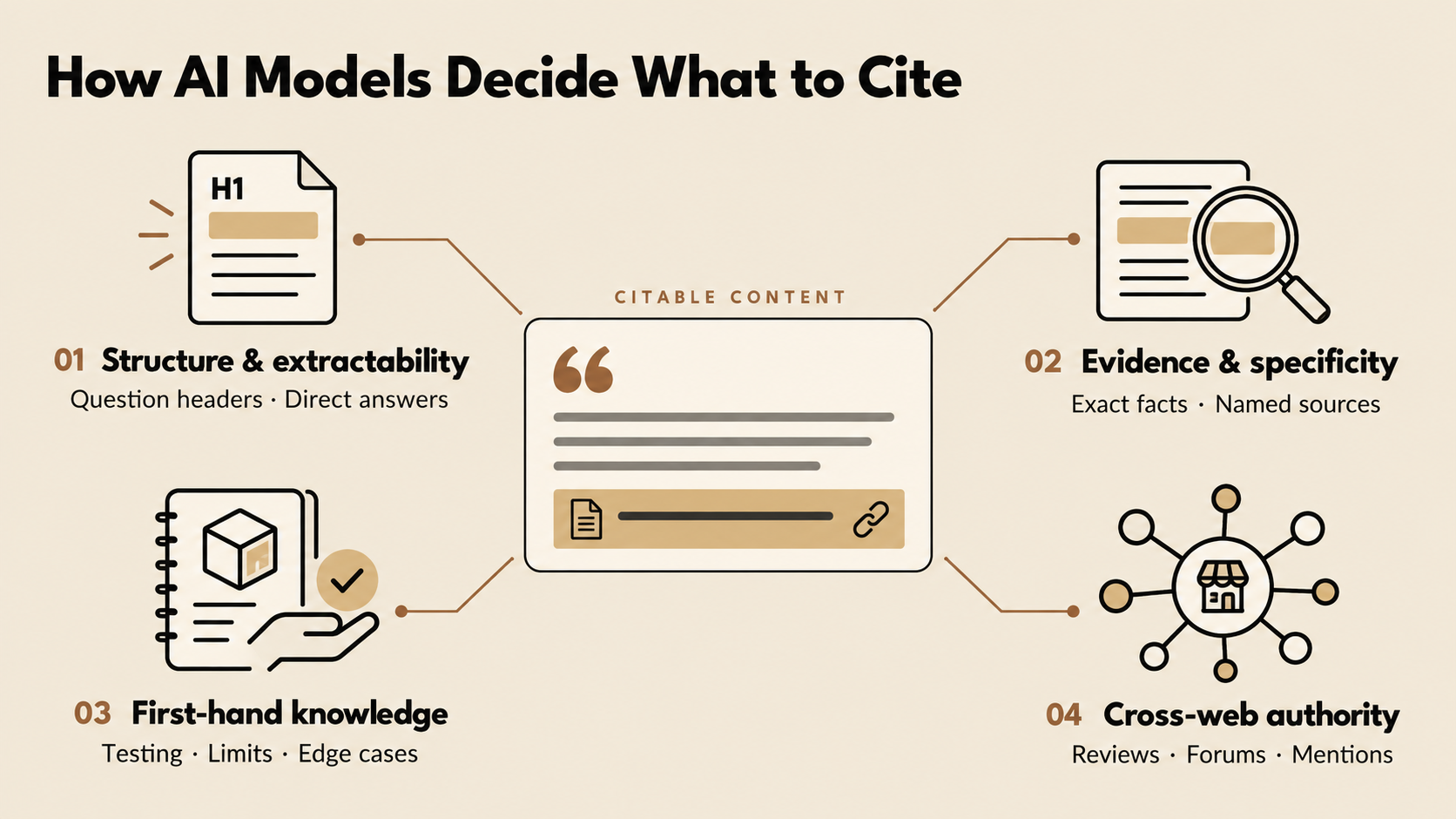
AI models decide what to cite based on four signals: how cleanly your content is structured for extraction, how specific and verifiable your evidence is, how clearly you demonstrate first-hand experience, and how consistently your brand appears across the web.
None of these are traditional ranking factors. Understanding why each signal works, and how to build for it, is where a GEO content strategy actually starts.
1. Structure and Extractability (The Technical Foundation)
Before an AI model can evaluate whether your content is worth citing, it needs to be able to parse it. AI crawlers don't skim the way humans do. They look for clean, predictable structure: question-focused headers, short answer blocks directly beneath those headers, and tables for data-heavy comparisons.
Pages that load via client-side JavaScript, or bury key points inside dense unbroken paragraphs, often can't be extracted cleanly. Structure isn't about aesthetics. It's the technical floor your content needs to clear before anything else matters.
What works:
Direct answer blocks: Write 40-to-60-word answers in the first two sentences under question-focused H2/H3 headers (e.g., "Can I use this tool for remote teams? Yes, and here's why...")
HTML tables for specs and pricing: Clean, structured data is trivial for AI to extract and cite
Server-side rendering: AI crawlers struggle with client-side JavaScript. Static HTML renders faster and more reliably.
Short paragraphs: 2-3 sentences max, one idea per paragraph
2. Evidence and Specificity (The Writer's Tactical Win)
AI models cite specific, verifiable statements that give readers something they can act on or confirm. The difference between "this tool is expensive" and "this tool costs $120/month for the unlimited plan" is the difference between content an AI skips and content it quotes.
This is also where junior writers gain the fastest ground. You don't need years of testing or a massive brand footprint. You need to be specific where everyone else is being approximate.
What works:
Named, dated sources: "According to NP Digital's 2025 study..." beats "Studies show..."
Exact pricing and tiers: "The Basic plan costs \(29/month with 5 user seats; the Pro plan runs \)99/month with unlimited users" beats "It's affordable"
Quotes from sources: Customer testimonials, founder interviews, and documented use cases
Visible update dates: A "Last updated: January 2026" stamp signals freshness. AI-cited content is 26% fresher than average SERP results.
The KDD 2024 GEO research found that adding authoritative quotes and statistics increased AI citation visibility by 30% to 40%.
3. First-Hand Knowledge and Topical Depth (The Content Strategy)
Generic content, the kind of summary pulled from a feature page with no evidence of real use, is easy for AI models to skip. What they favor is content that clearly comes from someone who has used the product, encountered its limitations, and formed a real opinion from experience rather than a product page.
That signal shows up in specific details: testing timelines, named configurations, and edge cases that only surface after extended use. Topical depth compounds it further. A blog with 15 detailed tool comparisons gets cited more reliably than one with a single roundup, because consistent, specific coverage signals genuine expertise.
What works:
Long-tail, buyer-specific use cases: Instead of "Project management tools: Top 5", write "Best project management tool for remote graphic design teams: pricing, templates, and workflow comparison"
Real buying signals from transcripts: Extract authentic buyer questions from sales calls or customer research. Write toward those exact pain points.
Edge cases and "where it fails": Acknowledging limitations builds trust and triggers AI citations. Buyers know perfection is fake.
Topical depth: A site with 15 detailed tool comparisons gets cited more often than one with a single roundup. Consistency signals expertise.
4. Authority and Cross-Web Consensus (The Brand Strategy)
AI models build consensus from multiple points of evidence across the web: your published content, third-party review platforms, YouTube channels, Reddit threads, and forum discussions. A brand that appears consistently across all of these carries far more citation weight than one with an excellent blog and nothing else.
This is the slowest signal to build. It's also the one that compounds most reliably over time, because once you've built cross-web presence, it's very hard for a competitor to displace.
What works:
YouTube visibility: Video mentions and view counts show the strongest correlation with AI citation frequency
Third-party review sites and forums: Mentions on Reddit, Quora, G2, and Capterra build consensus signals
Being quoted by credible sources: If other authority sites cite your work, AI models weight you higher
Consistent publishing: The same author or brand covering the same topic repeatedly builds topical authority
Real example: how query fan-out bypasses traditional rankings
Query fan-out bypasses traditional rankings by breaking one prompt into multiple focused sub-searches to deliver a complete, synthesized answer instead of a list of links. The clearest way to understand GEO in practice is to see how this plays out in real time.
*When a buyer asks Perplexity, "What invoicing software works best for my freelance design team?", it fans the prompt out into targeted sub-queries simultaneously:*
Best invoicing software for freelancers
Invoicing tools with multi-user/team access
Invoicing software integrations for design workflows
It then pulls chunks from each sub-topic and merges them into one cohesive answer.
The article that gets cited isn't necessarily the one ranking #1 for the original query. It's the one that directly answers the most sub-queries with the clearest, most extractable evidence.
Consider two pieces targeting the same buyer with completely different approaches:
SEO-Built Article | GEO-Built Article | |
Title | "QuickBooks vs. FreshBooks: Full Feature Comparison" | "QuickBooks vs. FreshBooks vs. Wave for Freelance Graphic Designers: Pricing, Invoice Templates and Workflow" |
Keyword target | 2-word keyword: "QuickBooks FreshBooks" | Long-tail buyer prompt, 5x longer |
Opening | General feature overview | 40-word direct answer written for designers |
Content | Broad feature list for all audiences | HTML pricing table, design workflow data, persona-specific verdict |
Off-site presence | None beyond backlinks | Mentioned in YouTube design reviews and Reddit r/freelance |
How it plays out
The SEO article ranks #1 on Google for "QuickBooks FreshBooks". But when Perplexity fans out across its three sub-searches, that article can't provide a clean, extractable answer to any of them. It's built for a keyword, not a buyer.
The GEO article opens with a direct answer written specifically for designers, includes a structured pricing table, and has been mentioned in YouTube design channel reviews and Reddit discussions. It answers sub-search 1, sub-search 2, and sub-search 3 cleanly.
Can you use GEO and SEO together?
Yes, you can use GEO and SEO together. The best-performing SaaS content already does. GEO and SEO aren't competing strategies, because they target different discovery channels. They share the same foundation: high-quality, well-structured, evidence-backed content that serves the buyer first.
The practical overlap looks like this:
Keyword research still matters, but the intent shifts: Instead of targeting 2-word keywords, you target long-tail buyer prompts (5x longer) that match how people actually phrase questions to AI tools. The research process is the same. The output is different.
Structure serves both channels equally: Clear H2/H3 question headers, short paragraphs, and HTML tables improve Google rankings and AI extractability at the same time. One content decision, two payoffs.
Evidence strengthens both: Named sources, exact pricing, and original data improve E-E-A-T signals for Google and citation likelihood for AI simultaneously.
The only real divergence is off-site strategy: Traditional SEO prioritizes backlinks. GEO prioritizes cross-web mentions on review platforms, YouTube, and forums. A combined approach builds both in parallel.
The simplest way to think about it: write for the buyer first, structure for AI extraction second, optimize for keywords third. In that order, you build content that ranks on Google and gets cited by AI without doing the work twice.
Does GEO strategy change depending on what you sell?
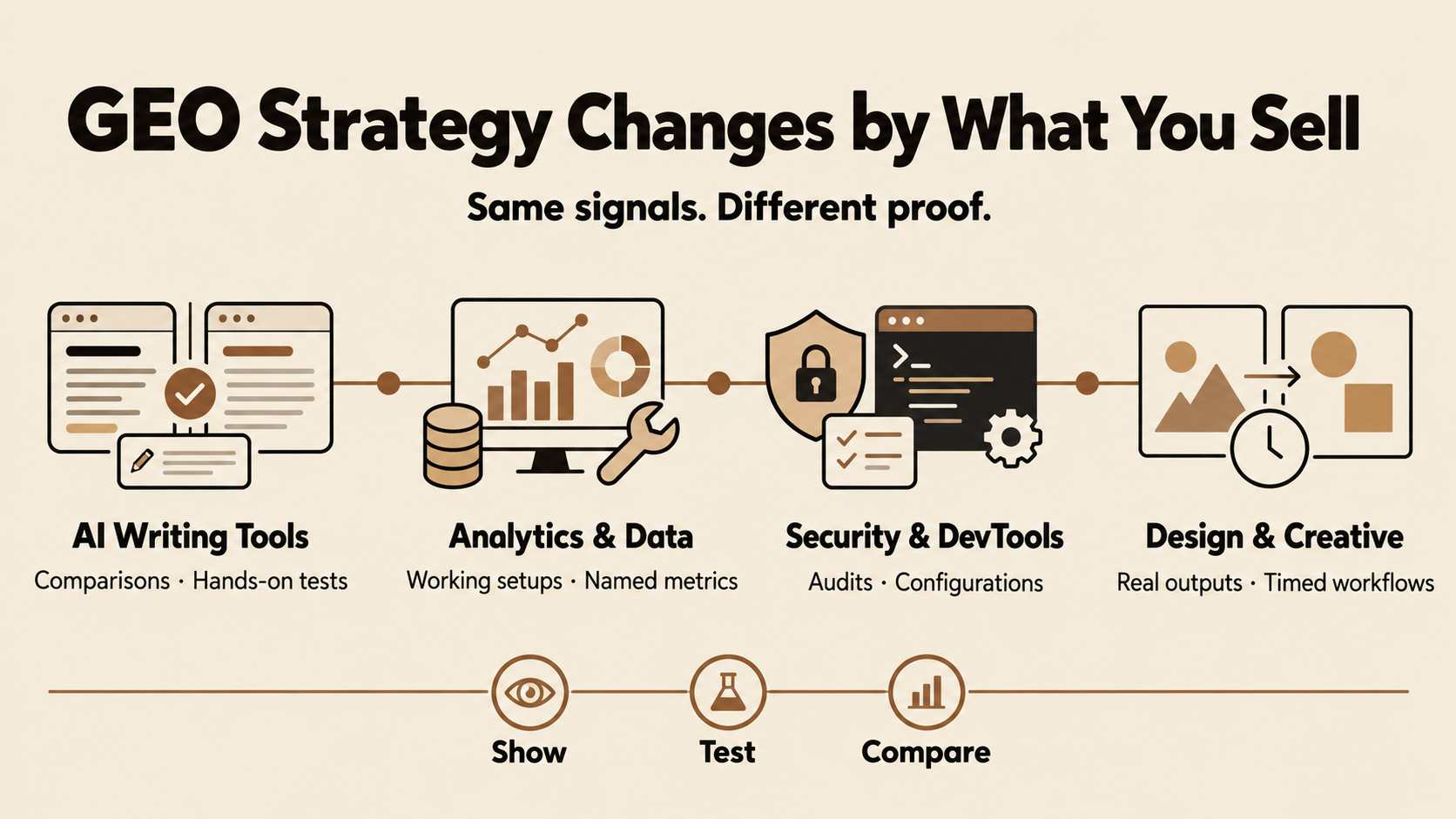
Yes, GEO strategy shifts depending on your SaaS category, but the underlying signals are the same. The difference is how you prove expertise. What counts as first-hand knowledge in a design tool roundup looks nothing like what counts in a security audit breakdown. The execution changes. The scoring logic doesn't.
Here's how GEO strategy applies across the four major SaaS verticals:
AI Writing Tools (Claude, ChatGPT, Perplexity): Buyers are literally asking AI models to recommend these tools, which means content about them gets cited at unusually high rates. The winning strategy is deep product comparisons with persona-specific use cases, hands-on testing with documented results, and clear verdicts on when each tool wins and where it falls short.
Analytics and Data Tools: Buyers care about implementation, not feature lists. A capabilities page doesn't close deals. Proof of a working setup does. The winning strategy is integration walkthroughs, real performance data, and before-and-after case studies with named metrics instead of vague claims about improving visibility.
Security and DevTools: Trust is the product. Vague claims don't work here, and AI models know it. What gets cited is verified, technical, and specific. The winning strategy is audit breakdowns, compliance documentation, and technical testing with screenshots of actual configurations, not marketing copy dressed up as documentation.
Design and Creative Tools: Visual proof carries more weight in this category than any other. A written claim about intuitive workflows means nothing next to a side-by-side output comparison. The winning strategy is workflow comparisons using real design outputs, productivity testing with timestamps, and integration guides for the tools designers already use.
Pro tip: Across every category, the same rule holds. Show instead of telling, test instead of assuming, and compare instead of claiming.
What Should Every GEO-Optimized Article Include?
To rank a GEO-optimized article in AI search, your content needs structure, evidence, depth, authority, and citation readiness.
Here's a quick checklist to run your article through before hitting publish:
1. Structure
Headers answer specific questions
Paragraphs are 2-3 sentences max
Tables used for pricing, specs, and comparisons
Each H2/H3 section opens with a 40-to-60-word direct answer
2. Evidence
Pricing is exact, not approximate
Update date is visible on the page
Every major claim has a named, dated source
Original data points included (screenshots, testing notes, real metrics)
3. Depth
The article is persona-specific
You cover edge cases competitors miss
You address "when NOT to use this" clearly
Real-world implementation is visible throughout
4. Authority
Author name and credentials are visible
Content is consistent with other articles on the same topic
You have or are building third-party mentions (reviews, YouTube, forums)
5. Citation Readiness
Conclusions are actionable
Sections are easy to quote in isolation
Specific claims with specific evidence throughout
Nothing contradicts what you said elsewhere in the piece
Frequently Asked Questions About Generative Engine Optimization
Is GEO the same as AEO? GEO and AEO are related but not identical. AEO focuses on getting cited as the direct answer to a specific query. GEO is broader, covering your overall brand visibility across all AI surfaces, including unprompted mentions. For most SaaS content teams, strong AEO executed consistently at scale is the most practical path to GEO outcomes over time.
Does GEO work for B2B SaaS content teams?
Yes, Generative Engine Optimization (GEO) works effectively for B2B SaaS content teams by helping brands secure visibility, trusted citations, and direct product recommendations in AI search engines like ChatGPT, Perplexity, Claude, and Google AI Overviews.
How long does GEO take to show results?
GEO results typically appear faster than traditional SEO because AI models favor fresh content and citation doesn't require a link-building campaign. Structural fixes like adding direct answer blocks under question headers can show citation impact within four to six weeks. Cross-web signals like YouTube mentions and review platform coverage take longer, often three to six months to compound.
What content gets cited most often in AI search?
AI search consistently cites content that is specific, structured, and fresh. Articles with question-based headers, direct 40-to-60-word answer blocks, named data sources, and visible update dates perform best. First-hand testing content and buyer-specific comparisons get cited at significantly higher rates than generic feature lists. Learn how to write content that gets cited.
Can one piece of content rank in Google and get cited by AI?
Yes, one article can rank in Google and get cited by AI. Generative engine optimization and SEO share the same foundation: clear structure, original evidence, and content that answers the question better than anything else. The difference is at the sentence level. For GEO, the answer has to land in the first sentence after every heading. That single change serves both channels.
How does GEO differ from SEO and AEO?
SEO gets your pages ranked in Google's search results, while AEO gets your content cited as a direct answer inside AI tools like ChatGPT and Perplexity. GEO is broader than both: it's about building your brand's overall citation presence across all AI surfaces, including unprompted recommendations. In practice, strong AEO executed consistently at scale is the most direct path to GEO outcomes.
If you're new to the AEO side of this, start here: AEO vs SEO: What's the difference, and which should you prioritize?
Where Do You Go From Here?
You now understand what GEO is. But knowing isn't the same as executing.
The next article in this series covers tooling: the 6 AI writing assistants I tested specifically for GEO performance, ranked by what actually moved the citation needle. After that, we get into measurement. What's getting cited, how to track it without paid tools, and how to iterate from real data.
If you want to go deeper before the next piece drops, these are worth your time:
I write about GEO, AI search, and content strategy for SaaS at Ujjwalsrivastava.com. If you want to follow the research as it develops or just say hello, you'll find me on LinkedIn.